

In my work implementing 360 processes over the last 30 years, I’ve partnered with organizations with a full spectrum of experience with 360 feedback — from launching initial pilots to managing mature, well-established programs. I’ve experienced how well-implemented processes help communicate and operationalize these programs to directly impact key business goals.
Below, I’ve articulated a step-by-step approach to thinking through those linkages between your 360 feedback program and your business goals, and some of the key questions to ask as you build out your program. Take a look and see where there might be gaps in your thinking and analysis, measurement and tracking, or employee communications.
Step 1 – Articulate Key People Strategy Challenges and Goals
During 360 feedback design discussions, I always ask the client about the purpose of their 360 initiative and how it fits into their broader development priorities and people strategy. Responses tend to either be in development language, for example, “We know we need to do more to develop our people and want to provide some feedback to help them,” or in competency language — “Here’s our new competency model that describes the critical competencies we want to focus on.”
However, when I speak to the most experienced senior talent leaders, the conversation is markedly different. They make a clear link from the development process and desired outcomes to the organization’s strategic priorities. Are you trying to build closer relationships with your customers, transform your business operations, or be on the leading edge in your industry? Think about your language when in conversations with your team, with senior leaders, and in wider employee communications. Participants in the 360 need to understand how the feedback process can help them achieve success in their roles and contribute to a thriving organization.
Step 2 – Identify Key Behavioral Changes Required
Next, I ask my client, “What are the key behaviors that are critical to successfully meeting your organization’s most pressing challenges and achieving your goals?”
Their response often comes in the form of organizational outcomes — “We need to be more agile,” “We need to make key decisions faster,” “We need to be more innovative,” “We need to coordinate better between our regions.”
Getting to clear individual behaviors that can be developed is certainly not an easy task – these changes can be interwoven with process and culture, but ultimately, all decisions are made by people, so understanding how behavioral changes by your employees can contribute to these outcomes is critically important.
For example, these are some common organizational behavioral changes that follow on from strategy change…
- Change of focus from internal to external stakeholders
- Change in collaboration approach to be more individual, team, or organizationally focused
- Change in how time is spent, e.g., learning, selling, talking to customers, building relationships with colleagues
- Reinterpretation of leadership approach, e.g., directing to advising, troubleshooting to mentoring
For organizations that already have a competency framework, these behaviors may have already been defined, but determining which of these are key business drivers is important. Your organization is likely doing a lot of the critical things well, or it wouldn’t be in business. Most competency models articulate all of these, but as a talent leader, your job is to focus the organization on what needs to change, while preserving key differentiators. So having a clear focus is important.
Similarly, individuals are doing a lot of things well if the organization is investing in their development. You aren’t trying to get people to increase competency scores across the board; you want them to invest their energy in focusing on the one or two things they can do that are going to have the most impact on the organization in achieving its strategic goals. Do you have clarity on what behavior changes are most critical to your organization’s future success, and are they being clearly communicated across the organization?
Behavioral change is often doing something different rather than doing the same thing better. This means a key component of change is making tradeoffs — stopping some activities and behaviors to enable others. This may result in a perception from others that performance is decreasing in some areas to focus on others, and that is OK. For example, focusing on a change project may mean the person is spending less time collaborating and listening to others in other areas of the business – are you working on creating an environment where this kind of experimentation can take place safely?
Step 3 – Target Key Behaviors for Development
Effective organizations are very clear that assessment feedback is just a data point and not a prescription. Putting the feedback into context with organizational and individual priorities and distilling one or two clear development goals is a critical step – one that needs support, whether that be with a coach, well-prepared mentor, manager, or other resource. The most experienced talent leaders start by determining how they will implement this critical part of the development process and build their 360 program around that. Those less experienced tend to build out the assessment process, then figure out the debrief and follow-up later.
Here are some key considerations when designing the development planning process:
- Ensure key performance goals are front and center when reviewing feedback. Development goals should be important for the individual in their role, be achievable, and will “move the needle” for the organization.
- Make sure participants ask the question — how will working on X help me achieve my and my organization’s short- or long-term goals? It’s easy to look at feedback and identify the areas where you are weakest – but that doesn’t mean you should focus on them.
- Help participants understand the team component – teams succeed when they collectively have the capabilities they need. Acknowledging areas where others are stronger than you, and leveraging their capabilities, is a valid solution to a capability gap. This thought process can only occur when the individual is grounding their development in solving real issues their team is facing, and not just addressing low-scoring behaviors on an individual 360 assessment.
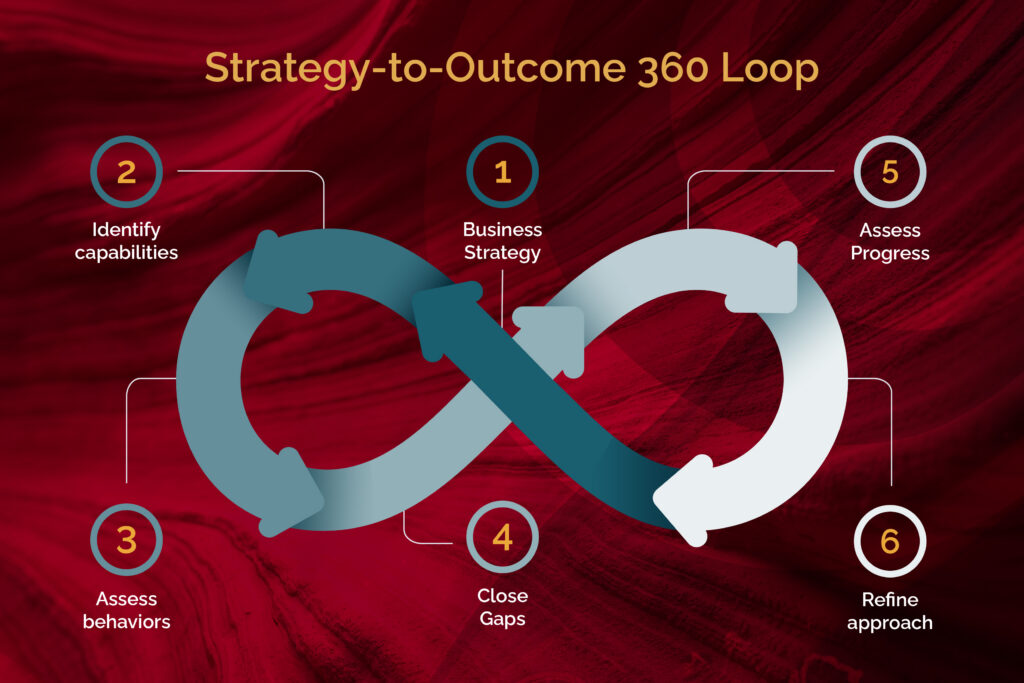
Step 4 – Evaluate Data and Adjust
Behavior Change – Are We Operating Differently?
Everyone can go through the process of setting and working on development goals, but that doesn’t mean they are working on areas that will impact the behaviors you’ve identified as being critical to your strategic goals. It can be helpful at a minimum to set up some basic reporting of competencies and behaviors being targeted for development, which can be done without compromising individual anonymity of coaching/development. Look at this data — do you need to enhance the focus on developing key behaviors? What can you do to support this shift?
Initial aggregate data will allow you to evaluate your assumptions about relative strengths within the organization and give you a baseline. Does the profile match your earlier evaluation of the organization? Are there specific areas that you need to address organizationally?
Once you have aggregate data over a year or two, sort your behavior scores from top to bottom before and after. Are there significant differences? Have you closed gaps or changed perceived strengths? Where change is lacking, are there specific areas that you can address organizationally? Are there barriers to change due to culture, policy, or process that need to change? Do employees have the support they need – are you providing the right combination of resources, training, and opportunities to develop?
Outcomes – Are We Achieving Our Goals?
Though direct causal links between development activities and organizational goals can be difficult to prove, you can start by tracking goals that are clearly dependent on addressing your people challenges, and evaluating progress and barriers in relation to competencies that are a focus for development.
If you design your goal-setting and reporting process well, you can get data on whether employees are making progress against their behavioral development goals, what business goals this has helped them achieve, and even put a dollar figure on the benefit.
A well-thought-out 360 feedback program is more than just a process of evaluation; it’s a strategic initiative that not only supports individual growth but also contributes to the success of broader organizational objectives. As you review your current initiatives or embark on new ones, remember the significance of strategic alignment throughout the process. Take the time to assess where you can improve, innovate, and support your employees in their growth. With a clear focus on behaviors that drive success and an environment that encourages experimentation, your 360 program can become a powerful catalyst for achieving both individual and organizational excellence.


'/%3E%3C/svg%3E)
'/%3E%3C/svg%3E%0A)
'/%3E%3C/svg%3E)


Get the latest insights in your inbox
Related Posts

When Appetite Outpaces Discernment: A Paradox in Executive Coaching

From Challenges to Growth: The Figure-Ground Dynamic in Executive Coaching