

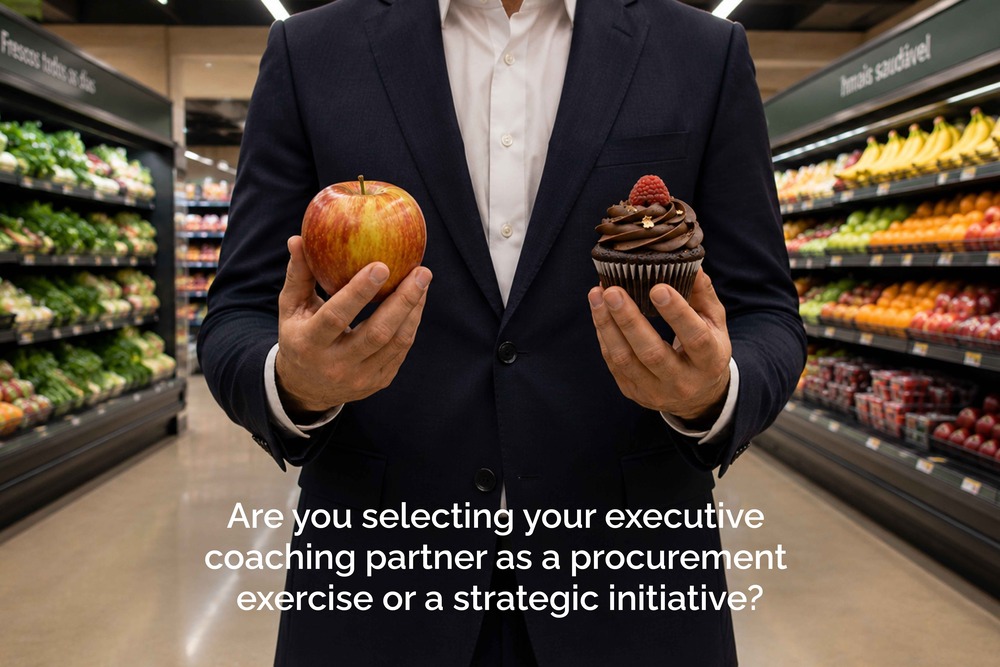
“Never go to the grocery store when you’re hungry.”
We’ve all heard this wisdom, and most of us have learned it the hard way. That hungry version of ourselves loads the cart with impulse purchases—things we don’t need, items that don’t align with our goals, products that looked appealing in the moment but don’t serve us well in the long run. In other words, when appetite rises, discernment tends to fall. By discernment, I mean our ability to thoughtfully and intentionally sort through all of the noise that may be going on inside of us or around us in order to make the best decisions that benefit both our short- and long-term strategic objectives.
I’ve been thinking about this dynamic lately in the context of executive coaching.
The Growing Appetite for Executive Coaching
Recently, someone asked me whether I thought the appetite for executive coaching has changed in organizations. My answer: absolutely, yes. Research continues to validate coaching as one of the most effective tools for executive development. Organizations increasingly recognize that developing their leadership pipeline isn’t optional—it’s essential for competitive advantage. In fact, a recent study by Spencer Stuart reports that “nearly 60% of C-suite functional leaders in 503 S&P 500 organizations are internal appointments, underscoring the importance of leadership development and succession planning to create robust pipelines for the future.”
The appetite has never been stronger. And yet, there’s an interesting paradox unfolding.
A Shift in Ownership
Over the past several years, I’ve noticed ownership for executive coaching procurement has gradually moved lower in organizational hierarchies. Where I once partnered directly with CHROs or senior internal coaching leads, I now more frequently work with senior managers and directors in talent development, learning and development, or human resources.
Let me be clear: these professionals are excellent partners. They’re dedicated, capable, and deeply committed to their organizations’ success. This isn’t about capability; it’s about context.
The Context Gap
The challenge is one of strategic visibility. Senior managers and directors may not have full line of sight to the CHRO’s broader mandate or the nuanced leadership challenges facing the C-suite. Without that context, the criterion for selecting coaching partners often defaults to what’s easily measurable: coach credentials and price points.
These factors matter, of course. But they’re insufficient on their own. When vendor selection becomes primarily about checking boxes and comparing costs, any provider with the right window dressing and competitive pricing can appear to be the “right partner.” The deeper questions—Does this coaching approach align with our leadership philosophy? Will these coaches understand our industry context? Can this partnership adapt as our needs evolve?—may go unasked.
The Cost of Reduced Discernment
When appetite for coaching grows while strategic discernment diminishes, organizations risk investing in development initiatives that don’t deliver meaningful impact. It’s the grocery store phenomenon playing out in corporate learning: hunger for a solution can lead to choices that don’t truly nourish.
The implications extend beyond wasted budget. Ineffective coaching can leave executives feeling cynical about development. It can create the impression that “we tried coaching and it didn’t work,” when in reality, the wrong coaching partnership was selected. Momentum for leadership development—so hard-won—can dissipate.
Bridging the Gap
So what’s the path forward?
For organizations: Consider whether the decision-makers for executive coaching partnerships have sufficient strategic context. If procurement has moved to capable mid-level leaders, ensure they’re equipped not just with budget authority, but with a clear understanding of leadership development objectives, insight into C-suite challenges, and direct access to senior stakeholders who can validate strategic alignment.
For procurement leaders: Don’t hesitate to ask for what you need. Request time with senior leadership to understand their vision for leadership development. Ask questions that go beyond credentials: How does this provider’s coaching philosophy align with our culture? What outcomes have they driven in similar organizations? How do they measure impact beyond satisfaction scores?
A Question of Alignment
The appetite for executive coaching reflects organizational wisdom—recognition that leadership development drives results. The key is ensuring that this healthy appetite is met with equally robust discernment. That means the right people asking the right questions to make strategic decisions.
After all, when we shop for executive development with full strategic awareness rather than a hunger for a quick solution, we’re far more likely to invest in partnerships that truly nourish our organizations’ leadership capabilities.
Strategic coaching partnerships don’t start with a checklist. They start with the right questions. → Schedule a leadership strategy conversation with Cambria.
Contact Us


'/%3E%3C/svg%3E)
'/%3E%3C/svg%3E%0A)
'/%3E%3C/svg%3E)


Get the latest insights in your inbox
Related Posts

From Challenges to Growth: The Figure-Ground Dynamic in Executive Coaching

Navigating the Paradox of Leadership Certainty